

“How much could we lose?” has no defensible answer.
Risk stays qualitative, inconsistent, or detached from a clearly bounded business scenario.
The decision gap
Leaders are asked to fund controls, accept residual risk, and approve consequential technology without a common economic view of the loss at stake. CISOs and technical teams create value that is often difficult to prove.

Scroll to explore · Up to rewind
The problem is not a shortage of findings, frameworks, or dashboards. It is the missing connection between what matters, the loss exposure, the effect of security capabilities, and accountable authority.
Risk stays qualitative, inconsistent, or detached from a clearly bounded business scenario.
Controls are justified by gaps and urgency rather than measurable changes in loss exposure.
CISO and engineering teams struggle to show how their capabilities change frequency or magnitude.
Assumptions age, conditions drift, and decisions outlive the evidence that originally supported them.
The evidence leaders are missing
A loss-exceedance curve shows the probability that annual loss will exceed a given amount. Compare the baseline with a modeled protection alternative, then test each against management’s acceptance limits.
See how capability value is quantified →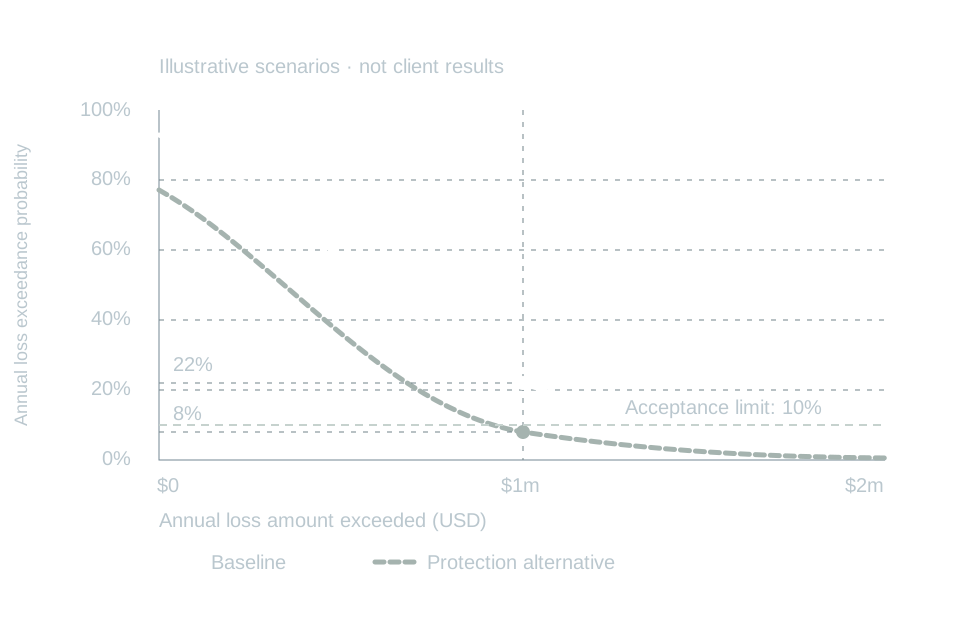
Marcriis is a consulting partner and a training partner. We work beside your teams, produce decision-ready evidence, and teach the method at every step so the organization can repeat it.
Frame the choice, quantify uncertainty and loss, compare protection alternatives, and document accountable authority.
Explore consulting →Turn each RDCD decision-chain step into applied learning, coaching, and reusable organizational capability.
Explore training pathways →From evidence to authority
Focus analytical effort on the activities and losses that matter.
Use distributions, evidence grades, assumptions, and sensitivity.
Connect people, process, and technology performance to risk change.
Make authority, commitments, tolerance, and reassessment explicit.
Protect what matters
We will help frame it, identify the right consulting or training path, and turn the work into lasting capability.